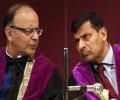
Reserve Bank will hold its first bi-monthly monetary policy review for 2016-17 on Tuesday.

High fiscal deficit and debt ratios remain one of the biggest constraints.

'The global situation is not very good.'
.jpg)
The growth has not been very robust in the first two financial years of the 12th Plan.

India's economy continues to be robust, but downside risks such as rising crude oil prices, adverse weather conditions, and the global banking crisis outweigh the upside potential in gross domestic product (GDP) growth in the current financial year (FY24), the finance ministry said on Tuesday in its Monthly Economic Review for March. "We reiterate that downside risks to our official forecast of 6.5 per cent for real GDP growth in FY24 dominate upside risks," the review said. "Opec's surprise production cut has seen oil prices rise in April, off their lows of low-seventies per barrel in March.

Inflation trajectory, domestically as also globally, is what will shape the economy, and therefore the market, over the next couple of quarters.'

The finance minister added that Indian government revenues are expected to increase by 21 per cent in the 2013-14 fiscal year.
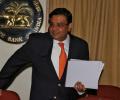
Fitch said the full implications of Patel's resignation will only become clearer once there is some indication of the RBI's policy approach under his replacement, Shaktikanta Das

The finance ministry on Tuesday cited "green shoots" of recovery in agriculture, manufacturing and services sectors, and said the prompt policy measures taken by the government and RBI have helped reinvigorate the economy with minimal damage. Stating that the agricultural sector remains the foundation of the Indian economy, the ministry said that a normal monsoon, as has been forecast, should support the rebooting of economy.
IMF chief Horst Kohler, who is in Dubai to World Bank Group and IMF meetings, did not comment on the issue of BPCL and HPCL divestment.

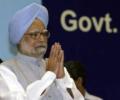
Former Prime Minister Manmohan Singh on Tuesday said the media needs to remain vigilant and flag shortcomings of the government with a view to improve the effectiveness of governance.
For a long time, the Indian economy has been drifting without a credible monetary anchor.

RSS-aligned Bharatiya Mazdoor Sangh (BMS) on Monday expressed disappointment over the government's budget proposals with regard to divestment and foreign direct investment, especially in the insurance sector. The BMS, however, lauded the government for its current efforts on the massive vaccination programme, a special scheme for tea workers in West Bengal and Assam, labour oriented push on infrastructure projects in construction sector and development of five major fishing harbours viz. Kochi, Chennai, Visakhapatnam, Paradip, and Petuaghat as hubs for economic activities etc. On other Budget proposals, it said in a statement that "mixing the beautiful concept of Aatmanirbhar Bharat with FDI and disinvestment in the Union Budget is disappointing for the employees".

RBI expects the growth in the next fiscal to strengthen gradually, notwithstanding the significant headwinds.

The International Monetary Fund (IMF) on Tuesday said it is expecting some slowdown in the Indian economy next fiscal year and projected the growth to 6.1 per cent from 6.8 per cent during the current fiscal ending March 31. The IMF on Tuesday released the January update of its World Economic Outlook, according to which the global growth is projected to fall from an estimated 3.4 per cent in 2022 to 2.9 per cent in 2023, then rise to 3.1 per cent in 2024. "Our growth projections actually for India are unchanged from our October Outlook.

The RBI, which has been keeping rates at an elevated level citing high inflation, wants it to come down to 6 per cent by January 2016.

The fragmentation of politics and the pressures of coalition management have contributed to a near-secular rise in budgetary social expenditures and spending on subsidies since 1991, leaving little fiscal space for government-led capital investment.

The Budget would preserve macro-economic stability.
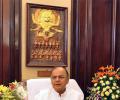
Modi govt faces extra spending burden due to policies like 7th Pay Commission and OROP
India's sovereign rating could be cut if the government loosens fiscal policy in the run-up to elections, says Fitch.

Over the next three - six months, UBS believes earnings will be the main driver for EM equities outperformance.

According to DMK, the voters are already consolidated on ideological lines, hence the impact of anti-incumbency, whether against the BJP Centre or the DMK state may not be too much, notes N Sathiya Moorthy.

The much-delayed Foreign Trade Policy (FTP), which will roll out steps to boost exports, is expected to be unveiled soon.

All policy planners want low interest rate, says Jaitley

Given the various risks to growth, one could argue for rate cuts to be deeper than the 5 per cent terminal repo rate that we are projecting at this stage, says Kaushik Das.

Rating agencies Crisil and Icra on Monday revised down their India growth projections for the current fiscal and the second quarter mainly due to the ripple effect of slowdown in global growth and mixed crop output. Crisil downgraded the India growth forecast by 30 bps to 7 per cent while Icra pegged the economic expansion at 6.5 per cent for the second quarter of FY2022-23. "We have revised down our forecast for real gross domestic product growth to 7 per cent for fiscal 2023 from 7.3 per cent, primarily because of the slowdown in global growth that has started to impact our exports and industrial activity.

The benefit coming in from the Rs 1.45 lakh crore tax giveaways will also help companies to cut prices by up to 5 per cent to boost consumer demand, which has been sagging and is one of the prime reasons for the deepening slowdown.
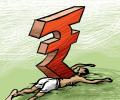
The bigger worry is that its effects could linger well into the next financial year.

While the RBI, in the recent past, appeared keen to move to an inflation-targeting framework, industry and academia remain divided on this issue.

What's different this time is that global financial stress -- which has its genesis in four policy choices made in recent years -- is juxtaposed with a more resilient real economy, observes Sajjid Z Chinoy, chief India economist at J P Morgan.

Fitch frowns at government pay hikes.

The Urjit Patel committee on monetary policy framework has proposed setting up of a monetary policy committee (MPC) that will be headed by the Reserve Bank of India (RBI) governor and accountable for achieving inflation target set by it.
With India's exports touching $80 billion in 2004-05, government on Friday announced a slew of measures in the new Foreign Trade Policy, aimed at taking the exports to $92 billion in the current fiscal.

Leading brokerages Nomura and Barclays on said current account deficit, which unexpectedly improved to 4.8 per cent in 2012-13, but still at a historic high, could moderate further this fiscal on slowing gold imports and cheaper commodities.
The government was considering further modifications in mega power projects policy, aimed at promoting capacity addition through fiscal incentives, Minister of State for Power Jaywanti Mehta told the Lok Sabha on Thursday.

'India's sizeable foreign exchange reserves should serve as a buffer.'
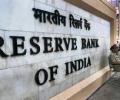
Industry body Confederation of Indian Industry said with the government having announced a clear road map for fiscal consolidation and non-food inflation demonstrating a secular decline, conditions are conducive for RBI to have intervened with a repo and cash reserve ratio reduction.

Gerard Lyons, chief economist and group head of research, Standard Chartered Bank, says that much will depend on monetary and fiscal policies undertaken.
Rating agency Moody's has described Budget 2007-08 as "largely unremarkable", as it disappointed businesses and the market's hope for meaningful economic reforms.

Lower revenue collection puts upward pressure on government borrowing, ensuring that it deviates from the glided path of debt reduction
 © 2026 Rediff.com - Advertise with us - Disclaimer - Privacy Policy - Sitemap - Feedback - About us - Terms of use - Grievances